Showing posts with label OT. Show all posts

Wednesday, April 17, 2013

Yoga for Special Needs Children: Strengthening Core Muscles


Photo: Children in Bow Pose,  artsriot.com 
Today I am happy to have a guest post from Craig Hanauer of Every Kids Yoga

Craig is a New York State Certified Creative Arts Therapist, a Kripalu Certified Yoga Teacher, and a Yoga Alliance 500-Hour Registered Yoga Teacher.

Committed to the health and empowerment of children, Craig has developed "Every Kid's Yoga", a unique and successful program for children with special needs, that integrates the creative arts, yoga, and play.

Today he writes about strengthening the core through yoga. The core is the area where all other movements originate from and Yoga can be a great way to support core strength as a supplemental activity for OT, PT and other types of traditional therapy. However, please use caution and common sense when selecting postures for children who have spine, joint or other weaknesses or injuries. Start with basics and build movements slowly, modifying and adapting as needed. Use the modifications that Craig has discussed below and if you are not sure if a posture is appropriate, please consult with the child's doctor and other therapists.

If you are not sure how to modify, or adapt, you can leave a question in the comments area for Craig or myself, or find more information in the "Related Articles" links below.


Yoga Strengthens Core Musculature

by Craig Hanauer

The muscles of the core include those surrounding the pelvis, those adjacent to the spine, and those surrounding the scapula, all lying closest to the bone. When these muscles contract, they stabilize the spine, pelvis and shoulder girdle, and create a solid base of support. One is then able to generate powerful and controlled movements of the extremities. The goal of core stability is to maintain a solid foundation and to transfer energy from the center of the body out to the limbs.

When working with children, Sheila Frick, OTR/L recommends placing emphasis upon activating the core musculature to achieve deeper respiration and to increase core strength and endurance. The goal is to develop the deep muscles that lie closest to the bone, especially the muscles providing three-dimensional support around the central vertical axis of the head, neck and trunk. It is important to maintain a continuous flow of breath with focus on the exhalation during core activation so as to coordinate movement with the breath.

When these deep muscles are engaged, postural control and breath support become effortless, as minimal conscious effort is required. Thus, surface muscles, designed for skill, are released from undesirable "fixing" and are instead able to function according to their natural design. When the body moves with ease and fluidity, the child is free to creatively and independently execute complex reasoning for communication, problem solving, planning, organizing and executing life tasks and roles.

Engaging young children in musical movement sequences that engage the core musculature and prompting them to sing along is a sure way to increase core strength and postural support.  If they are singing while they are "swimming" they are taking a deep inhalation followed by a long controlled exhalation.

[You can use "The Goldfish Song" K-2  (3:28), Laurie Berkner, from the CD "Victor Vito" ]


Movements:
  • Resting in prone position with head to the side
  • Cobra (wake-up)
  • Shake lower legs (shake out your tail)
  • Locust Pose with arms extended (swimming)
  • On knees act out shower and brush teeth
  • Supine position propped on elbows, bicycle/extend legs
  • Pat mouth and yawn (sleepy)

Modifications:
  • Gently touch below collarbones to prompt lifting the chest
  • If they are unable to lift their chest off the floor for swimming, place a pillow or folded blanket beneath the chest to provide support

Benefits:
  • Increases core strength
  • The song naturally vacillates between high and low energy
  • Children are engaged and grounded in one place
  • Simple chorus for singing along
  • Supports receptive language skills with simple acting out scenarios
  • Contains humor

Contact & Connect with Craig on 

Find Craig's Full Training Descriptions:  

To find additional adaptive yoga training, visit: 


Related Articles:

Breaking it Down

If You Give a Kid Their Core...

Games that Build Core Strength for Kids

Good Posture from the Ground Up


To find our growing library of
Webinars and Conference Call recordings 
visit AnyMeeting


Contact the blog administrator: bodylogique@yahoo.com 


.

Friday, June 1, 2012

In Case You Missed it: May 28-June1

"Late for Work" Photo: Patrick Breen
I hope everyone had a fun and productive week! Before I get myself outside for the day, I want to bring to you this week's "In Case You Missed It" post.

For those of you new to my blog, each Friday, we feature the top articles (archived and new) that are relevant to those who work with children with social, sensory and learning challenges. The purpose of this weekly post is to expand and improve the scope of resources & information for families, educators & other professionals. We want to build connections with diverse resources to help each other stay informed in the most straightforward and entertaining way possible. I hope you will pass it on and share with those interested.

To read the original article, click on the title links below. Its as simple as that!  Please feel free to share, with the original links & authors referenced.

If you have an article link you would like to add, contact Barbara at the e-mail at the bottom of this post. Guest post submissions are always welcome. Please report any broken links to Barbara at the e-mail link below.

Have a Fantastic Weekend!

~Barbara
barbara@bodylogique.com


Advocates Say  Yoga is "Ideal" for People with Autism
(Daily Camera)

Why the Midline is Important
(Sensory Edge)

Improving Sensory Integration Through Sensory Games

(BodyLogique.com)

Moving Smart: Safety Safari
(Moving Smart Blog)


Horse Therapy Helps Autistic Boy
(autismawarenesspage.com)


Should You Draw for Your Child?
(Janet Lansbury)


*A 'MUST SEE' Video (13 minutes)

iPad Apps for Autism
(60 Minutes-Video)


.

Thursday, November 18, 2010

Self Calming & The Four "B's"

I don't know if its just me, or if its the pre-holiday activities, but it seems that all of the children I have worked with in the past few weeks are just bundles of energy! Its been a challenge to get them to focus for more than short  intervals.

The Four B's is a technique that Pediatric OT, Lisa Baum showed me last week in our very energetic kids yoga class. Its a systematic calming process that she teaches her students to help them calm down, concentrate & regain self-control. Its very easy to teach to your child or students and this blog will take you through the 4 steps.


"Brake"
Brake:

The first thing Lisa has the children do is to put a "brake" on their excess energy.

She has them do this by pressing the palms of the hand together firmly as shown in the photo at the right. This helps to release excess muscle tension.
"Breathe"
Breathe:

Breathing is another vital tool in creating a sense of body awareness & restoring a sense of calm.

The children take a breath with their hands on their belly button, as shown in photo to the left, remembering to breathe deeply into the belly. (You can instruct your child to use 3-5 breaths)


Brain: 

"Brain"
By placing their hands in the top or towards the back of the head, and applying slight pressure, (as shown in photo to the right,) the child can 'activate' the brain, and create a sense of alertness & deeper calm.

This also will stabilize & "ground" the body.


Body:

"Body"
The final step in this process (shown at left)  is for children to cross arms in front of body and apply pressure as if to "hug" themselves.

The squeezing pressure on the arms and shoulders increases body awareness and assists in the sense of "grounded-ness" and security, which further calms the child and helps them stay focused.


These easy steps can be applied quietly and inconspicuously at home, school, church or synagogue, while at dinner in a restaurant (or in dance, yoga, karate or any other class) or anywhere a child needs to reduce fidgeting & regain a sense of focus, calm & self control.  Once the steps are learned, all that's needed is a gentle occasional reminder of  "Where are your 4 B's?".

* To download a FREE full color photo flash card of this technique click here or e-mail your request to: Barbara@bodylogique.com  .


For more information on our R.E.A.Ch™ program (Relaxation Education for Adults & Children) which teaches smany more stres reduction techniques, please visit Barbara at: BodyLogique.com 

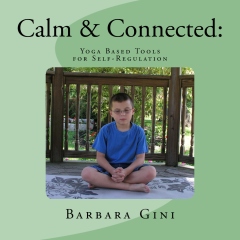
To purchase our "Calm & Connected" book on Amazon, click the links below:

Print Edition

Kindle Edition


For more information on Pediatric Occupational Therapy visit Lisa at:


.