Showing posts with label whole child learning. Show all posts

Wednesday, May 1, 2013

People Aren't Robots

Photo: Qatar Chronicle
When I was a kid, we had gym once a week and went outside after lunch every day. Sometimes, we would hold science class outside. We also would go up to the school yard after school-or out in the street-and play kickball, street hockey or just ride bikes. I often wonder why things are so different now?


School Physical-Ed, sports programs as well as art and music departments have been significantly impacted as administrations feel compelled to make curriculums more academically 'rigorous'.

We have a daily motor time in preschool and Kindergarten. Why do we suddenly stop this practice in upper grades and adulthood? We still need movement. Humans need movement. Movement is how the human brain grows and thinks. As one gym teacher puts it: "If the bum is numb, the brain is too."  Wise words.

Movement educators & PE advocates have been making the case that more time in the gym has not only physical benefits, but academic benefits as well. There has been a large body of research in neurology and brain development that supports this. The question is, if we know this, then why are we not applying it?

Something a friend of mine (also an athlete) said today in response to an article link I posted yesterday on this topic, struck me:


'There are so many aspects that are important. Giving the mind a break in the day so you don't get overwhelmed. Exercise is a natural mood booster. Social skills. Coordination. The list goes on... Some similar arguments can be made of Art and Music. People aren't robots. So frustrating! Good for the people who are out there fighting for what's right.'


People aren't robots...

No. We are not, and neither are our kids.

It IS frustrating. Given the increasing rate of learning & behavior issues in kids, general stress in schools AND in the workplace combined with the fact that we already KNOW the benefits of movement/exercise... it seems as if we have an answer to at least to some of the problems we face, but the powers that be, won't even acknowledge it, let alone apply it. They just keep imposing more rules and restrictions... and administering more tests to see how we're doing compared to the rest of the world-and putting more kids on medication before we've ruled out every other possible solution. Wouldn't be much easier for everyone involved to just put preventative programs in place before behavior and learning problems get out of control? 

Its frustrating & ridiculous, but most of all, its doing our kids a huge disservice.  Kids are not wired to sit still and listen to rote, lecture and do worksheets for 6 hours a day. Kids are not learning more in spite of 'enriched' curriculums and more instruction time. Kids are wired for fun & movement. They are wired for the novel and the unusual. Many classrooms are recognizing this and are incorporating some innovative types of group & blended learning methods. But for the rest, the kids are being routinely bored and/or traumatized on a daily basis-(NOT the teacher's fault!) and this is being sanctioned and sometimes encouraged by the state and US Boards of Ed. Our kids are being set up to fail, (and teachers are too) and parents and educators (and kids) are all expected to just deal with it-academically, emotionally, financially and otherwise.  

Well, the good news is, it doesn't have to be this way. A parent is a child's first (and best) teacher. So start by leading by example- get moving and get the kids moving too. I  know you are tired. We all are. We work hard to support our families. The movement will improve your energy level and do everyone a world of good. Resist the temptation to throw it all into a teacher's lap and say "Its his/her job to [fill in the blank]" Be proactive. Teach kids that if they need a movement or hydration break, to ask for one. They can stretch in their seat if they can't take a break. If they need to study more at home and put more effort into their academics, then they should. Be a good example and above all don't allow them to stagnate- to do nothing at home. There are plenty of everyday tasks at home to keep kids moving, engaged and connected with their families. 

Teachers, schedule daily movement breaks in the classroom-preferably at the beginning and halfway through.  Let the students water plants, (if you don't have any, get some. Not silk, not plastic. Real ones.) dance, stretch, yoga, Tai Chi, march in place, clean out desks, take a water fountain break, move furniture, have a "Chinese Fire Drill" and switch desks...it doesn't matter what type of movement it is, just encourage it. Three to five minutes per class period is all you need. If you can fit ten minutes in every half hour-even better, but start somewhere. You will find you get more done in less time.  Student cooperation and learning readiness will improve along with self-confidence, efficiency and motivation. At the same time, stress, lethargy and boredom will decrease. 

At first, you will feel silly-but give yourself permission to be silly-even with High school students who need it the most-along with the cognitively, socially or sensory challenged. After just one week, you will notice a difference in the atmosphere and demeanor of the class. I promise you.

Smithfield Elementary in south Charlotte, SC has figured out a way to balance physical movement time with the increased academic requirements: students take a "Brain Break" every 20 minutes.  The kids dance, maybe do a few calisthenics while counting by fives or saying their multiplication tables.  She says kids are more engaged and teachers actually feel like they fit more reading and math into the day.

Its your classroom-(and parents, they are your kids). Take charge and use what works. After all, we are not Robots.

To read the full article that inspired this post:

PE Advocates Argue Gym Benefits Not Just Health but Academics Too

To help get kids moving, you can find some inspiration on our You Tube Channel or find our Sensory Games and Activities 

To learn how to incorporate more movement into your classroom or home environment, visit our BodyLogique Online Workshop & Training Page (Schedule is currently being updated for Summer and Fall classes, 2013.)


To contact us with questions: bodylogique.info@gmail.com


.


Monday, March 4, 2013

Encouraging Eye Contact: What NOT to Do

Photo: artistshelpingchildren.org
One of the most upsetting things I observed during my time as an ABA therapist was the common practice of manually turning a child's head to encourage eye contact. In many cases it caused meltdowns & fear. In other cases, the child would just simply close their eyes tightly. It never did make much sense to me how forcing a child to look at you would somehow cause "spontaneous engagement." In fact, it caused the child to avoid the teachers that did this regularly.

There is already an imbalance of power between a child and an adult-and a student and a teacher/therapist- and I have always found this practice to be more about the adult's /therapist's needs than the child's. Its more like an intimidation technique rather than something done for the child's "own good" . The child knows you are not their "partner" if you are always trying to get compliance by using positive and negative re-enforcement. Naturally, they will at some point resist, to try and take back some of the power that has been taken from them, as they should. Besides, isn't it more logical & healthy to cause spontaneous engagement by being more engaging?

Well there is now a new study out of England that explains why we should NOT force eye contact on our students. I came across this article (link below) this morning and I am posting it here because I think its extremely important to understand that children are not (usually) intending to be willfully non-compliant, rude or all of those things that they tell a new ABA therapist or Para-professional. There is a reason that they are not looking at you, and the reason makes perfect sense. (Thank you Gwyneth Doherty-Sneddon, associate dean at Northumbria University in England.)

When a child's senses are overloaded, they need to filter out some of the input they are receiving. Since visual input takes up about 80% of our brain power, it makes logical (and neurological) sense that a child would attempt to block out that input in order to listen to you better.

In listening to better, they can then think about what the input is (such as an instruction or question) process it, and formulate a response. This process may take longer in children with sensory & learning challenges-(much like "dial-up" instead of "high-speed internet") so you need to wait for a response.

I was always taught that 7 seconds was appropriate for a response-however I really disagree with that time frame and think a child should be given more time to process if they need it. Everyone is unique-and all of our "programming" is different-and interrupting that process by placing a time limit on when they should respond, in my opinion, is absolutely ridiculous. We only do it because we've been doing it for so long. We need to change it if we truly want the kids that have the capacity for it, to be more independent. Maybe this research is a step in the right direction. (I have to add here that while I am not a therapist, I have worked with children with autism & other special needs since I was 14, and this is the common sense evidence that I have personally observed over the last 34 years.)

Its interesting to note that neuro-typical children (and adults) avoid eye contact when thinking too. How would you feel if someone grabbed your face and turned your head to face them when you were thinking of a response or taking notes during a staff meeting or workshop?

Its definitely something to think about.

Encouraging Eye Contact Disturbs Autistic Kids' Thinking


Recommended Reading:

The Way I see it: A Personal Look at Autism & Asperger's (Temple Grandin)

(Expanded Edition) In this innovative book, Dr. Temple Grandin gets down to the REAL issues of autism, the ones parents, teachers, and individuals on the spectrum face every day. She offers first-hand knowledge, helpful do’s and don’ts, practical strategies, and try-it-now tips, all based on her own perspective and a great deal of research. These are just some of the topics Dr. Grandin discusses:

  • How and Why People with Autism Think Differently
  • Economical Early Intervention Programs that Work
  • How Sensory Sensitivities Affect Learning
  • Behaviors Caused by a Disability vs. Just Bad Behaviors 
  • The Role of Genetics and Environmental Factors in Causing Autism
  • Understanding the Mind of a Nonverbal Person with Autism
  • Finding Mentors and Appropriate Colleges
  • More!


Contact: barbara@bodylogique.com


.


Tuesday, February 26, 2013

The Importance of Comfortable Shoes

'Shoe Circle" by Jenna Lynn


“The shoe that fits one person pinches another; 
there is no recipe for living that suits all cases.” ~ Carl Jung 


We all know how important comfortable shoes are. 
When our shoes pinch us, we can't think of anything else except getting relief-
and a pair of shoes (or slippers) that don't hurt our feet.

This is how I see special education & adaptive learning: 
parents & educators supply kids with many styles, colors and varieties of shoes,
for different purposes, and each child tries them on, to find the ones that don't pinch.

What type of shoes fits your child best?


Find this Original Image:

"Shoe Circle"


Visit: 


Tuesday, January 29, 2013

Forgetting What You Know (How to Start Thinking & Creating)


Photo: Jacob Barnett, You Tube

Forgetting what we know is essential to learning by, thinking and creating.

Educators and Parents: For a few minutes today, forget everything you know. Stop learning & just watch, think & create with this amazing young man!

Jacob Barnett is an American mathematician and child prodigy. At 8 years old, Jacob began sneaking into the back of college lectures at IUPUI. After being diagnosed with autism at the age of two and placed in his school’s special ed. program, Jacob’s teachers and doctors were astonished to find that he was able to teach calculus to college students.


Jacob is also CEO and founder of Wheel LLC, a business he started in his mom’s garage, and is in the process of writing a book to help end “math phobia” in his generation.
Jacob’s favorite pastime is playing basketball with the kids at his charity, Jacob’s Place. It is a place where kids with autism are inspired every day to be their true authentic selves…just like Jacob.
In the TEDxTeens video below, Jacob urges us to: "Stop Learning & Start thinking & Creating"

I think the bigger lesson to be learned for parents & educators is this: when that "difficult" or "non-compliant" student is not communicating or jumping through our educational/social hoops, they just might be thinking and creating beyond our perception. 


I am so inspired right now to forget everything I know (and start thinking & creating...)


Jacob Barnett TEDxTeen talk


Contact: barbara@bodylogique.com 


.

Friday, January 11, 2013

In Case You Missed It: ALL Kids are Smart Kids


When the S.M.Art Kids® Programs were born, it was with the idea that ALL kids are smart kids.

We recognize that each child has their own skills, gifts and talents and each child learns at a pace and manner that is unique to him or her. Some of these skills and talents are difficult to measure quantitatively.

The elements of our programs (stories, movement & art) were not selected randomly. They were included deliberately with sensory-challenged children in mind . Each element addresses & integrates one or several of the senses.

In addition, each element is linked to one of the 8 Intelligences . Angela Moorad SLP from OMazing Kids Yoga calls them, the 8 Pathways to Learning. (See first article link below for an article with 2 great diagrams.)

The idea, or theory of Multiple Intelligences, developed by Harvard researcher Howard Gardner, is that humans have potential in a variety of areas and learn in different ways.


What Are the 8 Intelligences?

  •   Linguistic Intelligence (“Word Smart”) – The ability to use words effectively; effective use of spelling, vocabulary, and grammar. [Examples in Everyday Life: talking, listening, reading (e.g., traffic signs, novels, poems), writing (e.g., letters, e.mail, reports, poetry]
  • Logical Mathematical Intelligence (“Numbers Smart”) – the ability to work well with numbers and/or to be adept at logic or reasoning. [Examples in Everyday Life: balancing checkbook, understanding the national debt, understanding budgets.]
  • Spatial Intelligence (“Picture Smart”) – The intelligence of pictures and images. The ability to visualize pictures or objects in one’s mind, to abstractly create in 2 or 3 dimensional form. [Examples in Everyday Life: arts & crafts, decorating your house, landscaping.]
  • Bodily-Kinesthetic Intelligence (“Body Smart”) – The intelligence of the body or body parts (e.g., hands), fine-motor coordination. [Examples in Everyday Life: playing sports, dancing, working under the hood of a car, unscrewing a jar of mayonnaise.]
  • Musical Intelligence (“Music Smart”) – The capacity to carry a tune, remember musical melodies, have a good sense of rhythm, enjoy and appreciate music.[Examples in Everyday Life: sing in a choir, play a musical instrument, enjoy music.]
  • Interpersonal Intelligence (“People Smart”) – The ability to understand and work with people. [Examples in Everyday Life: listening to others, encouraging or understanding others, motivating others.]
  • Intrapersonal Intelligence (“Self Smart”) – The intelligence of self-understanding or self-knowledge, of knowing who you are, of knowing what you are good at and what you are not good at. [Examples in Everyday Life: reflecting on one’s goals and beliefs.]
  • Naturalistic Intelligence (“Nature Smart”) – The ability to identify and/or a sensitivity to natural forms (e.g., birds, flowers, trees, animals, clouds, geological formations).[Examples in Everyday Life: gardening, camping, supporting ecological causes.]
Proposed 9th Intelligence
  •  Existential Intelligence (“Life Smart”) – The intelligence concerned with ultimate life issues.[Examples in Everyday Life: reflecting on the meaning of life, reflecting on religious or philosophical issues.]


We all have the intrinsic ability to learn in each of these ways, but in general, we primarily gravitate towards one or two of these qualities that we prefer, or are uniquely 'wired' to learn in one way over another.

Many educators are beginning to recognize the unique ways in which children learn and are finding creative ways to incorporate these concepts into the classroom.

How do you learn best? Find out! Take this Learning Style Quiz at Edutopia.

This week's links center around the science of learning. Enjoy!


Eight Pathways to Learning

Research Projects: Multiple Intelligences

Autism & the Fear of Intellectual Variability

A Creative Brain for All Children

When Students Seem Stalled

The Motor Story: Teacher's Corner

How Classroom Layout Affects Student Learning

Autism, Overactive Brains & Teen Social Adjustments

Kindergarten Readiness

The Connection Between Emotions and Learning

The Best & Worst Learning Tips 


*Do You have a "Learning Link" or resource to add? Please leave it in the comments section below!


Contact: barbara@bodylogique.com 


.

Thursday, December 6, 2012

Finding Your Something


Photo: noahsmiracle.blogspot.com/ 

I remember as a young first time parent, hearing other parents talking about their child's milestones: the first step, first word, riding a bike, etc. and I remember the anxiety that went along with it, wanting my son to be able to keep up with their peers. I didn't want him to be left behind.

He not only kept up with them-he went past them. He was an A student, taught himself to play several instruments, wrote music, won science fairs and scored a 1080 on SAT's in the 6th grade. He mastered and could play baseball, football, chess and hockey well. He was called 'gifted' and he hated that label. Classmates made fun of him constantly for any reason-for his clothes, for his insights- for being bright enough to hold intelligent conversations with adults. All he wanted to do was blend and "belong". 

While he loved to learn, the social aspects of life as a child/teen escaped him and he felt much more comfortable around adults rather than his peers. To cope, he developed an incredible sense of humor and refused to do homework. He almost did not graduate, not because he couldn't to the required work, but because he had so many missing homework assignments. He understood the concepts enough to get A's on tests, and felt homework was unnecessary busy work. He now has found his comfort zone writing & performing comedy sketches in and around Philadelphia. He has an incredible sense of empathy and forgiveness in spite of not being treated well by his peers as a young boy.

By the time my second son was 5, I had stopped stressing over development and just let him be himself. I offered a variety of opportunities to explore, and he did. He was intensely observant, always looking for the fun & was never afraid to try something new. A stocky child, he got teased for his weight. He also is gifted-in different ways than his brother. His gift is that he can size a person up almost instantly. The somewhat dark side of that gift is that he can find some one's weak spot and put them in their place if need be. This was and still is his way to cope. He has also taught himself to play several instruments (including a didgeridoo of all things) can cook just about anything under the sun (and never uses recipes) and has learned and managed every aspect of the restaurant business since he was 14.  He is self-taught, never went to college, and is one of the most naturally intelligent people I know. He is compassionate, but less forgiving then his brother. If you hurt or betray him or his family, you don't exist anymore. With him, you get one chance and that is all-he epitomizes efficiency.

By the time my daughter came along, 15 years after her brothers, I was a much more relaxed mom-(or maybe just a tad bit tired!) My daughter has taken what I thought I knew after almost 30 years of parenting and shown me a very different picture. She is kind and compassionate-creative and funny- but is a spitfire when she is lied to or betrayed. She is full of energy, exploration and enthusiasm and is still finding her gifts and trying them on to see how they fit.

These three children are so completely different, that if you stand them next to each other, they do not remotely resemble each other in personality or physical appearance. Each one is a reflection of how they have learned to see the world; Each one has gifts that will continue to help them learn; Each one will accomplish many things in their own time and will hopefully use those gifts to help to make the world a better place.They have all taught me something about myself, and this has helped me do my job better.

I have a motto that goes: "Not all children can do all things-but all children can do something."

All kids -and adults - have their unique "Something" and I think one of the most important gifts we can give our children - whether its our own kids or the students we work with - no matter their label- is to allow them as many opportunities as we possibly can, to play, create, explore - find (and unwrap) their "something".  

I love watching kids as they are engaging in their self-guided learning: they pick things up if they want to, examine them to the degree they are interested, use them in ways they were and were not intended, and put them down when they are finished. Its our job to make the introduction to concepts through engaging, fun activities -and sometimes to the gifts they don't realize they have yet- and show them how it works. Then, let them go with it. 

A parent is a child's first teacher-and as teachers we are inspiring them to discover-rather than imposing knowledge on them. Play & creative activities are the best ways to do this. Respecting their boundaries, allowing them to set the pace, and even letting them fail, gives them the confidence to explore that which truly interests them, and to "unwrap" their own "something" as they become ready to acknowledge and use it.


Time for some sharing & bragging: What are some of the incredible "somethings" that your children posses? Please tell us about them by leaving a comment below. Be as detailed or as brief as you like!


Contact: barbara@bodylogique.com 


.

Friday, November 30, 2012

In Case You Missed it: Learning Through Play


Photo: M&H Online

play/plā/

Verb:
Engage in activity for enjoyment and recreation rather than a serious or practical purpose.
Noun:
Activity engaged in for enjoyment and recreation, esp. by children.
Synonyms:
verb.  perform - act - toy
noun.  game - performance - drama - sport


For me, the last 2 months have been filled with life changes, hellos and goodbyes, transitions, stress (storms)  
and schedules, etc. and I think its time to start to get back top where I was when these crazy events started-
and lighten up a little bit. 

This week's posts are related to play. I've even included some links to our educational (and sensory) toy recommendations.

If you have an article link you would like to add, contact Barbara at the e-mail at the bottom of this post. Please report any broken links to Barbara at the e-mail link below.

Have a Play-Full Weekend!


~Barbara


The Value of Recess and Outdoor Play
(Education.com) 

The 4T's: Trusting Children as Learners
(Jeff's Blog)

A Day in The Afterschool Program: Helping Children Make Good Choices
(Marimouth.com)

Transforming Play Areas
(Engage for Education)

The 5 Best Toys of All Time
(Geek Dad) 

Yoga Added To Elementary School Lesson Plan
(VOA News)

Playing for the Future
(M&HOnline)

Worth Repeating: In Defense of Board Games
(PediaStaff)

Parents, Encourage Physical Activity!
(PKIDs Blog)

Headbanz-
(One of my Favorite Family Games)

Rory's Story Cubes
(Fun for Kids 8-12)

Textured Tangle
(For visual and tactile sensory fun!)

Create a Face
( Promotes fine motor skills, creativity, imaginative thinking and emotional awareness. Got to Love Melissa and Doug!)


"Play is the only way the highest intelligence of humankind can unfold."   ~Joseph Chilton Pearce, Contemporary American scholar


Contact: barbara@bodylogique.com


Monday, November 5, 2012

Three Destructive Myths Educators Still Believe


The part if my work that I enjoy most, right next to the creative process, is the process of helping others to learn. Giving valuable insight and relevant information so they can in turn it into something positive, inspiring or just pass it on to someone else is one of the most satisfying parts of what I do.
Through my own learning process, as well as through first-hand experiences, I have uncovered many untruths and myths that I believe not only hold educators of all kinds (including para-educators, yoga teachers, mentors, parents, etc.) back from doing the most good, but also inhibit the very students that we are trying to help.
Here are three of the most destructive myths related to general education special education, coaching and enrichment/recreational programming, that I would like to dispel today:

  • The Anxiety Myth: 


What words would you use to describe how yow you feel when you're performing at your absolute best? I'm guessing that "anxious" or "stressed" are not on that list, yet educators and therapists are still using methods that create anxiety/false scarcity through comparing students to one another and using "rewards" or "punishments" for behavior or work quality . 
The Truth:
While stress and anxiety may at times be a source of energy during a crisis situation, and setting goals can keep one focused, when competition, rewards and punishments are consciously used to "motivate" students on a regular basis, it is counter productive and will come at a huge cost not only to learning, but also to the teacher-student relationship, level of trust and to the physical and mental health of all involved.
When we are anxious, or feeling threatened, the brain goes into "fight or flight" mode. This is the mode we go into when we are in danger and we need to fight for our safety or run away from that very danger. This is also known as the "stress response". This is an automatic response that we cannot consciously control. 
During a stress response, our brains flood with a chemical called adrenalin that is designed to make us react-not think. When we are reacting we are not thinking clearly or imaginatively. The brain cannot tell what kind of anxiety it is: (are we in danger or is someone just getting on our nerves or did we just watch a scary movie?) it will react in the same manner regardless of what kind (real or imagined) of threat it is.
The more intense and sustained the stress, the more adrenalin will flood the nervous system and the more reactive we become. Think of the number of times a day you attempt to "motivate" your students with the widely accepted but outdated "Punishment/Reward" system: (Example: If students don't have a task completed in X minutes/days, then a punishment/restriction will happen. OR... Only the students who do such and such task or behave in such and such manner will get ABC prize.) This number represents the number of times we unintentionally cause anxious, stressed brains to shut down.
As an educator, your position of "authority" already creates an imbalance of power to your students. Rewards and punishments only increase that divide and serve to impose fear, stressful expectations and interactions. In addition, these manipulative methods only work on a very temporary basis if at all. Besides, have you ever trusted someone who was constantly trying to manipulate you? Or listened to someone whom you were afraid of?
As a yoga teacher, I spend much of my time working one-on one with children-as young as 6- who have anxiety, and teaching them simple, useful methods to manage & counter-act their stress response. Its a skill that cannot be over-emphasized, but its only half the solution.
In the classroom, studio or on the field, any time your words, methods or actions are used to emphasize the imbalance of power (whether it is between teacher/coach and student or among peers/team mates) — or prompts negative, anxious emotions and reactions from your students— fear, stress and anxiety will greatly increase. (I often think of my days as an ABA therapist and how much anxiety I must have caused my students who were depending on me to support them.) In this stressful, imbalanced environment, students are less likely to cooperate and learn/perform effectively. They are more likely to try and take back their power through rebellion. 
If they do mange to get by and complete a task or an activity it will not be about "learning" but about "compliance" and "survival", and will only last until they can get away from that environment and you. Everything they have learned will be distorted or lost completely, and the internal motivation and the joy of learning for fun will have been severely damaged.
The Solution:
Learn ways to reduce stressful interactions and create a more Calm and Connected environment in your classroom or studio. The more supportive, positive and motivating your energy is, the more your position yourself as a partner in learning to be respected, rather than an authoritative educator, to be feared. The more approachable you are, the calmer and safer the students will feel to explore and learn. When you can do this effectively, the more positive and cooperative student's energy is likely to be, and the better the long term outcomes for all concerned.


  • The Multitasking Myth:


Somewhere along the line we have been led to make the assumption that: children are capable of doing and should be expected to do two cognitive tasks at the same time. They are not and should not. And I have news for you, neither are adults. We may think that we do and even brag that we have trained ourselves to move rapidly between many tasks. So rapidly that while we are doing one thing, we're not even aware of the other. Stop and think for a moment if this is really a good thing?
The Truth: 
According to Professor David E. Meyer, Ph.D, of the University of Michigan, switching time between tasks (multitasking) increases the amount of time it takes to finish the primary task you were working on by an average of 25 percent. Likewise, having students juggle and switch from many activities at the same time is an incredibly inefficient way to teach and for students to learn. (Especially students with cognitive processing delays and other challenges.)
The human brain can only fully process one thing (effectively)  at a time. Period. Stop fooling yourself. Just like a vehicle needs a minute to shift gears, or your computer needs time to load a program or a page, the human brain needs time to shift from one activity to another. When the brain gets overloaded it either shuts down or melts down.
The Solution:
As challenging as it is to focus on just one idea or task at a time in the middle of endless distractions faced in a classroom or studio, it's by far the most effective way to teach.  Work on one skill or task (or yoga posture) at a time and be sure students understand not only the task or skill, but when to apply it, before moving on to the next. Children will learn more and retain it longer. Transitional activities, such as games, movement/stretching or a quick riddle/puzzle will also help keep kids engaged and help them transition to the next activity with minimal stress.

  • The Homework Myth:


In my opinion, no single myth is more destructive to students and teachers than the myth about homework. The best way for a student to learn and get more work done, is for them to work longer in the classroom and at home with homework. 
The Truth:
Children are not designed to operate like our computers — at high speeds, continuously, and for long periods of time. In fact, science has told us that our mind naturally wanders every 7 seconds. If you ever have really observed a child playing or doing a "free" time activity, you will notice that their attention varies as they move and interact. Its very different than adults: they switch intermittently between periods of intense engagement/activity/interaction and periods or inactivity/silence/rest. Great teachers and administrators use this to an advantage and adapt a schedule that correlates: they recognize that it's not the number of hours students work that determines the value of learning, but rather the energy, assimilation and personal meaning they apply to their learning during leisure time.
The Solution:
Breaks, hydration, rest and renewal through out the day makes it possible for students to digest lessons and learning in smaller chunks, and keep up energy and concentration steady all day long. Strategically alternating periods of concentration/work with intermittent fun, rest or even a movement break, at least every 30 minutes, (every 60-75 minutes for adults) makes it possible to help students learn more & get more done, in less time. Homework assignments, if given, should be used sparingly. They should be creative, fun, motivating and designed to creatively demonstrate how the lesson applies (or can be applied) to a child's personal life, goals or interests.

Tell Us:

What are some of the Myths that you have uncovered during your career as an educator, therapist or coach?  
What methods or techniques have you used with the best intentions, that later proved to be counterproductive? 
Please tell us in the comments section below.

Learn more about us at: BodyLogique.com 
.


Wednesday, September 19, 2012

Pirate's Pose and Other Landlubber Folly


Ahoy, me Hearties!

Avast ye:

Its "Talk Like a Pirate" Day!

(No- for real! I can't make this stuff up! Look here at the Official Talk Like a Pirate Day Website )

So celebrate with ye lads & lassies with a Pirate-y Poses (see below) as ye build ye bodily strength... AND test ye listening skills, body agility and teamwork, with a tomfoolery game of  "Shipwreck", (game courtesy of Playworks).


And don't forget ye pirate eye patch.

Savvy?


Pirate Pose
 Be a "Pirate":
(Variation of Warrior ll)

Main Focus:
overall posture, particularly shoulders

How You Do it:
  • Stand with Right foot in front, toes pointed forward, and left foot in back, toes pointed slighlty to the left.
  • Bend right knee in front as shown.
  • Open arms, reaching left arm behind to rest on left calf and right arm (with 'sword', 'feather-sword' or 'spyglass') stretching up.
  • Arch back slightly and breathe in deeply.
  • When you exhale, say "Arrrrggggghhhhhh! " 
  • Hold posture for 3-5 breaths, then reverse right and left arm & leg positions.
  • Adapt posture for children with poor muscle tone by allowing them to sit on a chair, a therpay ball or have them do the posture standing with front leg straight instead of bent.

BONUS POSES:


Pirate's Ship Pose
 Sail a "Pirate's Ship"
(Also known as "Boat Pose")

Main Focus:
core & thyroid

How You Do it:
  • Sit on Floor with legs together & out in front.
  • Lean back slightly, bend knees and lift legs up using stomach muscles.
  • Keep back straight-not rounded as you balance on bottom and reach forward to grasp legs as shown.
  • To add a level of challenge and build strength, straighten legs while remaining balanced.
  • To adapt for children with poor tone, allow them to use hands on floor behind back to brace and support the body as they bend knees and pull legs up off floor.

Sea Monster Pose
Spot a "Sea Monster":

Main Focus:
a freestyle posture that allows children to creatively explore balance, fluid movement and body awareness.

How You Do it:
  • Stand tall with feet together and arms at sides.
  • Begin to move through the "water" with arms and legs-as if looking for Pirate Ships to capture (or play with)!
  • Make a Sea Monster face-and Sea Monster sounds!
  • Do the pose to music, "Musical Chairs" style: when the music stops, the Sea Monsters must 'freeze'-music starts, they continue moving on.


Mermaid Pose
Meet a Mystical "Mermaid":
(Modified "Fish Pose")

Main Focus:
posture-spine & belly

How You do it:
  • Begin seated on floor with legs straight out in front.
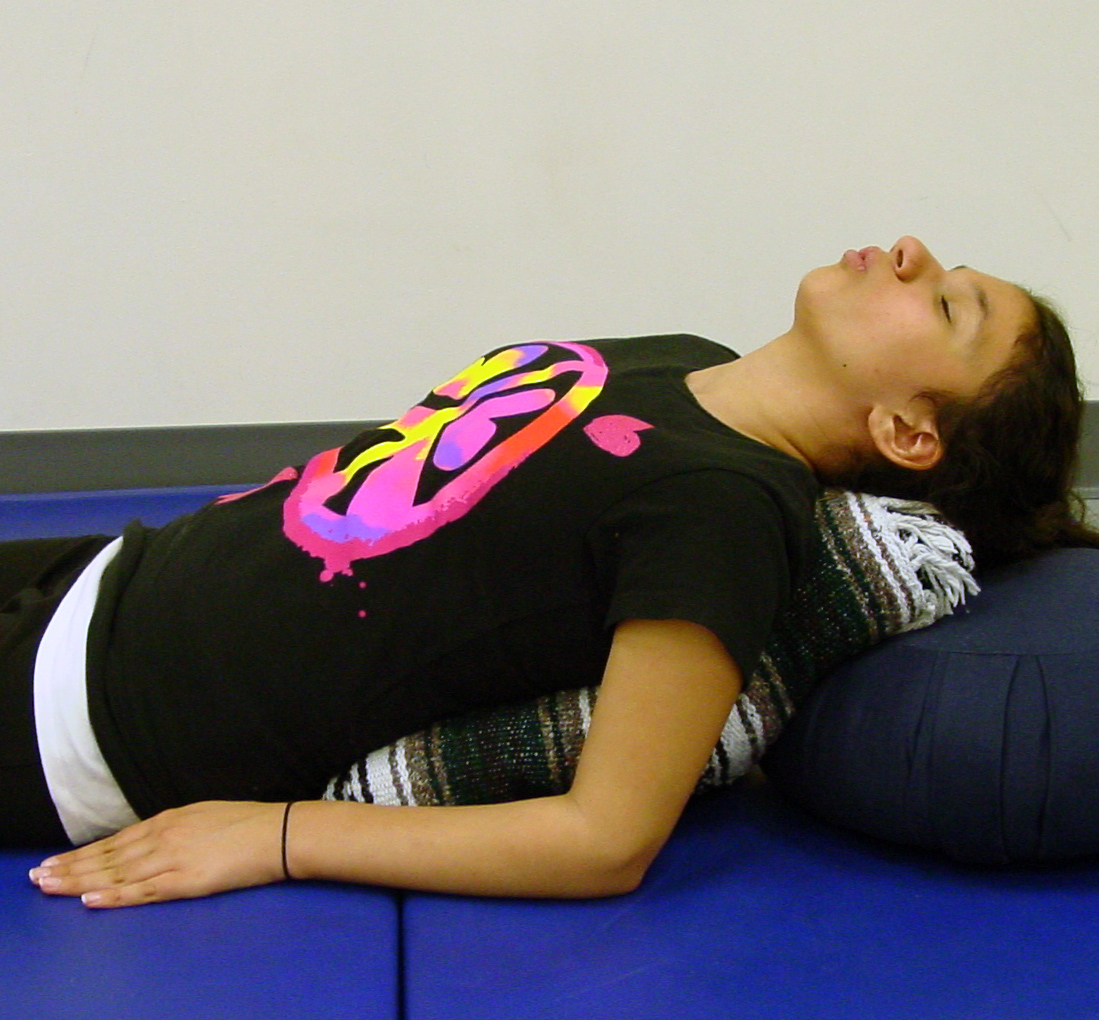
  • Lean back, resting on elbows as shown
  • Modified Mermaid
  • Lift chest, arch back slightly and let head gently entend to the back.
  • Breath in, and blow out 'bubbles'...
  • To modify, use bolsters and firm folded blankets to support chest and head as shown in photo at right.


More Valuable Booty ( Links) for ye...


Ye Pirate Phrases

Ye Pirates in the Clasroom ( Includes lesson plans & resources for teachers,
speech language therapists & adapted activities for non-verbal children)

Ye Pirate Festivals


See ye later Mateys!

Arr!
A Pirate-y Pool Noodle
Spy Glass


Contact ye captain:

barbara@bodylogique.com