Showing posts with label sensory games. Show all posts

Wednesday, April 10, 2013

Welcome! Now Get Out!


There was a slogan in Pennsylvania when I first moved here:

"Welcome to Pennsylvania! Now Get Out!" It was part of the "Get Outdoors PA" campaign.

The idea was to get families out and involved in the many outdoor events & activities that are available here: kayaking, hiking, miles of bike trails, paddle boats,nature centers, parks... Its one of the many things I love about living in Pennsylvania.

So today, I came across this video (below) and thought immediately about how I could adapt & use this in a summer camp program?

The game is simple-(the best ones often are) and looks like SO much fun for kids (and grownups)! Its called "Chair Ball" from Thailand-who wants to play?

Ideas? Suggestions? (After you watch, please leave your ideas in the 'comments' section below!)


http://youtu.be/DU8PuctY8WQ


So now I know you hesitated-I could feel it. And I know why. We've been conditioned to think of all the bad things that could happen instead of how beneficial (and fun) an activity is.

I want you to stop thinking about how dangerous (standing on a chair with a big basket over your head) is-

or the many ways how someone could get hurt-

or how the kids will get dirty-

or that someone will be upset because they didn't win…

These are just excuses.

Just GO PLAY with the kids and TEACH them how to be safer-how to clean up when they are finished-and how to lose-(and win)-gracefully! The benefits outweigh the dangers. Trust me. trust the kids. Trust yourself as an educator and as a human.

Now Get Out!


*Click Here for a printable copy of this article (with live & QR Code  links)


Contact: barbara@bodylogique.com 


.


Friday, February 8, 2013

In Case You Missed it: Winter Activities for Families


Photo: J. Yugel, 1998
The snow has started to fall here, and I am making a huge pot of fresh chicken orzo soup with tons of vegetables.

As Canada, New England & parts of the east coast brace for a major winter storm, many of us start thinking about food, supplies, safe travel and what will we do if the power goes out?

Besides board games (or as my daughter some-times calls them 'bored' games...as in we only play them when we are bored,) there are hundreds of other things you can do to relax & reconnect with each other.

Here is my quick list of  fun activities-indoor and outdoor- that the whole family can participate in.


Please stay safe, dry, warm & active this weekend everyone!


Unexpected Snow Days Arsenal (5 Minutes for Special Needs)

Sensory Smart Winter Tips

Outdoor Winter Activities

Snowmen at Night  (Literacy/Kids Yoga)

10 Indoor Winter Fun Activities for Kids

12 Activities to Beat Winter Cabin Fever

Keeping Warm with Winter Sensory Diets

Hot Cocoa Bar

Snow Cream

Kids in the Kitchen

Flip 2 Be Fit (Indoor/Outdoor Family Fitness Board Game)

More Winter Activities

Families Unplugged: Activities Fit For a Storm


*BONUS*


(Free Downloads from BodyLgique.com)


Contact: barbara@bodylogique.com 


Monday, December 10, 2012

12 Days of Christmas Game

Photo: intmath.com 


Have you ever asked yourself  where some of the words to Christmas songs came from? Why a Partridge and why a Pear Tree?

From the earliest human writings, trees have symbolized many things, through the power of nature of their special attributes. In many cultures, birch is the tree of health, wisdom, and safety, was used in baby cradles and cribs. Cedars were the trees of paradise in the mid-East. They were also symbols of faithful lovers in China and held as sacred in Nepal.

Junipers were planted as protection from thieves and witches & Oaks have been known as the symbols of strength and power. In China, pine was the symbol of friendship in adversity since it remains green all year.

In Germany, it was customary to plant a tree at a wedding. As each child was born, an apple tree was planted if it was a boy and a pear tree for a girl. The age and amount of fruit the trees bore were thought to give strength to the marriage and the respective children.

But what about Pear Trees?

In the Chinese culture, the pear symbolizes longevity, as pear trees are known to live long. Marco Polo reported after his travels that the Chinese planted many trees because they believed "he who plants a tree will live a long life."

But as far as the Partridge in the Pear Tree and the origin of the Holiday Song, The Austin Public Library research department found  that words from this song first appeared in a book published in 1780 (or 1783) in England titled "Mirth Without Mischief."

The melody apparently dates back much further and originated in France. The book describes "The Twelve Days of Christmas" as a "memory and forfeits game" played by children at that time.

The leader recited the first  verse, the next child recited the second verse, and this continued until someone missed his or her verse and had to pay some kind of penalty in the game. "The Twelve Days of  Christmas" became popular at the "12th-night parties" (Feast of the Eppiphany) that took place during the Christmas season.

You can play a fun adapted version of this game with your children or students to help improve concentration, auditory processing, sequencing and memory skills.

The 12 Days of Christmas Game: 

You can modify the words as follows:

"On the first day of  Winter Break my teacher gave to me..."

(Or  if playing with family, 'On the first day of Christmas/Hannukah my Grandma/Nonnie/Baba gave to me...')

For younger children who can read, you can print out or write the names of the 'gifts' down on gift tags (or slips of colored paper or paper snowflakes) using one tag for each player. The gifts can be animals, toys, foods, characters or any theme you select.

You can also play this game with non-readers, using miniature animals or other items placed in a grab bag. The children each select an item, and hold theirs up when its their turn, as they recite the poem. Prompt as needed.

Each player selects a tag or slip of paper to see what their 'gift' is. Instruct them to not tell anyone what they selected. The teacher then begins by saying or singing:

"On the first day of  Winter Break my teacher gave to me...(Example: ) a Cardinal in a pine tree."

The second student takes his/her turn: "On the second day of winter break my teacher gave to me...(Example) 2 white gloves and a cardinal in a pine tree."

Each child continues reciting or singing the gifts, first saying their own, and then the others before them.

(Examples:) Three French Fries... Four Angry Birds... Five Golden Teeth....Six Bags of Licorice...Seven Fruit Cakes...etc

If needed, the other participants can be asked to prompt, help give clues or guess the gift if the player gets stuck.

The teacher then goes last, reciting each gift-(pretending to struggle and prompting the children to help remember what the sequence is.)

The gifts can be nontraditional-and relevant to what children like to do. Footballs, bicycles, iPads, Super Mario Games, etc.

For older children, they can each come up with their own 'gift' in the sequence. Play as above.

In order for non verbal children to participate, use photos, illustrations or PECS. Print out the pictures and laminate. Prompt them to  hold up their picture when their turn comes. (Do not require them to recite the entire sequence that came before them unless their skills will allow it.)


Learn some fun math facts about the 12 Days of Christmas

*What are some other winter or holiday games that you play with your family in doors, out doors or in the classroom? We would love to hear about them! Please leave a comment in the box below.


Contact: barbara@bodylogique.com    

Friday, December 7, 2012

In Case You Missed It: Educational Toys

One of the things I miss about having young children is going into toy stores. I think I used to have more fun than the kids-trying the new items that came out each year.

I'm slightly removed from the toy loop as my kids have gotten older, but one of the traditions I started years ago is to purchase one toy or game for each of my kids to remind them to embrace that creative, playful part of us that lives on no matter how old we get. Last year it was Silly Putty (which I had once banned forever because some was left on a couch by my young sons and I sat on it and ruined an expensive pair of wool pants.)

One year I got a busy box for my then 21 year old son, because he liked to examine and touch everything he saw. (He still does). That was the same year I got a bag of extra Mr. Potato Head parts for my other son who worked in the culinary industry and was always cutting himself and getting more stitches. He liked to show off his scars. I gave him the extra parts that "Just in Case" he needed them. They both loved the gifts and had fun sitting there playing with them on Christmas morning

One of toys that I most use as a teacher would have to be the Hoberman Sphere (otherwise called the "Breathing Ball"). This versatile toy can  not only be used to teach children how their chest and lungs should properly expand and contract while breathing, but also is visually attractive & encourages concentration.

Each year at holiday time, I do my best to find gifts that are not only fun but functional & educational. Using the imagination through play is the best way for children learn.

I've compiled a short list of 9 favorite toys and games for kids this week: most are appropriate for sensory development and adaptable to special needs. I've included a description of the item, the skills each teaches and why its one of my favorites. These are all toys that I myself am familiar with and have used with my own kids, family members or students. I've included links to each so you can decide for yourself if its right for your child. This post is a bit longer than usual, but I wanted to give as much information as possible.

Feel free to add your own favorites in the comments section, along with a link if possible, or your own critique and tips if there is a toy listed here that you have purchased for your child. You can also list toys that you did NOT like-and tell us why. I'd like this post to become a growing resource for everyone's holiday gift giving.

Happy Shopping and Have a Play-full Weekend!

~Barbara

PS-At the very bottom of this post I've included a link to a news story I saw this week that saddened me. It shows little children in India being used for labor to make holiday ornaments. At this time of year, which should be a happy time for children, I urge you to please know what you are buying and where it came from. We've all bought the "cheap" ornaments at the dollar stores, and I know its impossible to know who made it and under what conditions,  but I know after seeing this I will be more conscious of what I am purchasing and the person who helped make that item.

I've also included a link to "Toys for Tots" and "Operation Christmas Child". I hope that if you are able, you will participate in their Holiday toy drives. This is a great way to teach kids about the spirit of giving, gratitude & helping each other out in times of need.


Hoberman Sphere - (Pictured at top): This unique and eye-catching Expanding Mini-Sphere is perfect for for all ages and abilities. You can spin, roll and suspend it. It can be used for breathing & self-calming exercises for kids. Expands from 5.5" to 12".  I love them because these spheres inspire children to be creative and inventive. They come in larger sizes as well as a glow in the dark version.

Snap Circuits- This toy offers children ages 8 and up, and exciting, hands-on introduction to electronics. The kit contains more than 30 color-coded, real circuit components that snap together & combine to create working circuit boards just like the ones found inside televisions, radios, and other electronic devices. Snap Circuits provide hands-on education in how electrical circuits work to run the everyday devices that we are familiar with. With 100 do-it-yourself projects & easy-to-follow instructions, this toy lends itself to an entertaining, concrete education on how electronics work. I love the creative aspects and the fun projects: a sound-activated switch, a musical doorbell, a voice-controlled lamp, a flying saucer, and a light police siren. Kids can experiment with things like electric switches, integrated circuits, digital circuits, fuses, and the transforming circuit sounds into other sounds.

Spot It ! - I love this game for younger children & preschoolers, ages 4-7. Its a fun way to improve visual perception,pattern recognition and practice matching. There are several versions of the "Spot It" games-the link provided goes to the "Animals" version. Colorful (& adorable) animals appeal to younger children. The round tin travels easily in backpack, pocket or in the car. Each card is imprinted with 6 different animals of varying sizes and there is only one single matching animal between any 2 cards. there are 5 different games that can be played competitively or not. I also love the adaptability of this game to ages and ability.
Huggtopus

Kimochis-Huggtopus Box Set -Kimochi (Key.Mo.Chee) means "feeling" in Japanese. Kimochis are small pillows with a feeling (happy, sad, silly, brave) printed on one side, and a matching facial expression on the other. This toy helps develop healthy social and emotional skills. Each character comes with a set of three feelings and a "How-To" Feel Guide. (there is also a Cat, a Bug,(caterpillar), a Dove, a Rose, and a Cloud.) Each of the characters have a pocket where Kimochis (or feelings) can be stored. I love the character identification that takes place: by using these characters, children can learn about & understand their emotions through puppetry and play. (Huggtopus is very affectionate and strong and sometimes gets a little carried away by her big friendly personality. She always means well but has to learn about boundaries; Bug is a caterpillar who is afraid of change. He is thoughtful cautious and has a secret dreams of flying...etc.The Guide introduces the personalities of each character and offers parents tips and activities to help engage & strengthen relationships & connections. I also highly recommend the Kimochi Mini Mixed Bag (contains 12 different feelings) along with the Huggtopus or any of the characters. Well worth the money. 

Nature Kaleidoscope Making Kit - Kaleidoscopes are visually calming, due to  the symmetry of colors and shapes, and encourage communication between both sides of the brain if used equally on both eyes. (We are primarily dominant in one eye, just as we are with hands, feet, ears, etc. To determine which eye is dominant, place the scope on the table directly in front of your child, and let him pick it up and look through it. The eye he brings it up to is "dominant". Be sure that the non-dominant eye is also used for viewing to encourage development of the opposite side of the brain.) I love that this kit encourages creativity and allows you to make your own kaleidoscope over and over again using a variety of natural elements: dried flowers, polished gemstones, glass marbles and minerals. The kit contains parts for an 8 1/2" scope, two nature drawings to color as wraps and colored pencils.  Kids age 7-11 love to create and build things that are personal to them, and this is a perfect gift for filling that desire.

Therapy Ball Cards - 60 Fun therapy ball activities for kids age 4 and up to help keep them active & build body awareness, upper body and core strength, motor planning, visual perceptual skills, fine motor skills, and improve proprioceptive  input. There are four categories: Sitting Activities, Prone (Tummy) Activities, Standing and Other Activities, and Stretching Exercises. Each 3x5 card has an illustration of  activity & the back lists benefits, directions, and other tips for using therapy balls. I love that these cards are compact and come in a protective storage tin for easy transport. 
Kids Yoga Deck

Kids Yoga Deck - My all-time favorite yoga card deck for introducing yoga and exercise to kids. (I have used with ages 4 and up). It is useful, versatile, simple, visually attractive and colorful for kids & stimulates creativity and fun! With several categories, 50 playful poses and games, simple instructions and a durable storage box, these cards can be carried and used easily for a variety of purposes by yoga teachers, classroom para-educators, therapists and parents. Kids can also use the cards independently-even if they have limited language skills or can't read yet. 

Discovery Toys - Any and all of them.  I never met a Discovery Toy I didn't Like! Here is a link to my Facebook friend Arlene's page. Here is the Main Discovery Toys page.

Mr. Potato Head - A nostalgic favorite! Read this Pedia Staff article on the many therapeutic uses for Mr. Potato head and you will see why you should get one-or two-right now! 


*Please include your additions to this list below!


Enslaved Children Freed After Being Forced to Make Christmas Decorations

Toys For Tots Foundation


Operation Christmas Child


Contact: barbara@bodylogique.com

.


Friday, November 30, 2012

In Case You Missed it: Learning Through Play


Photo: M&H Online

play/plā/

Verb:
Engage in activity for enjoyment and recreation rather than a serious or practical purpose.
Noun:
Activity engaged in for enjoyment and recreation, esp. by children.
Synonyms:
verb.  perform - act - toy
noun.  game - performance - drama - sport


For me, the last 2 months have been filled with life changes, hellos and goodbyes, transitions, stress (storms)  
and schedules, etc. and I think its time to start to get back top where I was when these crazy events started-
and lighten up a little bit. 

This week's posts are related to play. I've even included some links to our educational (and sensory) toy recommendations.

If you have an article link you would like to add, contact Barbara at the e-mail at the bottom of this post. Please report any broken links to Barbara at the e-mail link below.

Have a Play-Full Weekend!


~Barbara


The Value of Recess and Outdoor Play
(Education.com) 

The 4T's: Trusting Children as Learners
(Jeff's Blog)

A Day in The Afterschool Program: Helping Children Make Good Choices
(Marimouth.com)

Transforming Play Areas
(Engage for Education)

The 5 Best Toys of All Time
(Geek Dad) 

Yoga Added To Elementary School Lesson Plan
(VOA News)

Playing for the Future
(M&HOnline)

Worth Repeating: In Defense of Board Games
(PediaStaff)

Parents, Encourage Physical Activity!
(PKIDs Blog)

Headbanz-
(One of my Favorite Family Games)

Rory's Story Cubes
(Fun for Kids 8-12)

Textured Tangle
(For visual and tactile sensory fun!)

Create a Face
( Promotes fine motor skills, creativity, imaginative thinking and emotional awareness. Got to Love Melissa and Doug!)


"Play is the only way the highest intelligence of humankind can unfold."   ~Joseph Chilton Pearce, Contemporary American scholar


Contact: barbara@bodylogique.com


Wednesday, September 19, 2012

Pirate's Pose and Other Landlubber Folly


Ahoy, me Hearties!

Avast ye:

Its "Talk Like a Pirate" Day!

(No- for real! I can't make this stuff up! Look here at the Official Talk Like a Pirate Day Website )

So celebrate with ye lads & lassies with a Pirate-y Poses (see below) as ye build ye bodily strength... AND test ye listening skills, body agility and teamwork, with a tomfoolery game of  "Shipwreck", (game courtesy of Playworks).


And don't forget ye pirate eye patch.

Savvy?


Pirate Pose
 Be a "Pirate":
(Variation of Warrior ll)

Main Focus:
overall posture, particularly shoulders

How You Do it:
  • Stand with Right foot in front, toes pointed forward, and left foot in back, toes pointed slighlty to the left.
  • Bend right knee in front as shown.
  • Open arms, reaching left arm behind to rest on left calf and right arm (with 'sword', 'feather-sword' or 'spyglass') stretching up.
  • Arch back slightly and breathe in deeply.
  • When you exhale, say "Arrrrggggghhhhhh! " 
  • Hold posture for 3-5 breaths, then reverse right and left arm & leg positions.
  • Adapt posture for children with poor muscle tone by allowing them to sit on a chair, a therpay ball or have them do the posture standing with front leg straight instead of bent.

BONUS POSES:


Pirate's Ship Pose
 Sail a "Pirate's Ship"
(Also known as "Boat Pose")

Main Focus:
core & thyroid

How You Do it:
  • Sit on Floor with legs together & out in front.
  • Lean back slightly, bend knees and lift legs up using stomach muscles.
  • Keep back straight-not rounded as you balance on bottom and reach forward to grasp legs as shown.
  • To add a level of challenge and build strength, straighten legs while remaining balanced.
  • To adapt for children with poor tone, allow them to use hands on floor behind back to brace and support the body as they bend knees and pull legs up off floor.

Sea Monster Pose
Spot a "Sea Monster":

Main Focus:
a freestyle posture that allows children to creatively explore balance, fluid movement and body awareness.

How You Do it:
  • Stand tall with feet together and arms at sides.
  • Begin to move through the "water" with arms and legs-as if looking for Pirate Ships to capture (or play with)!
  • Make a Sea Monster face-and Sea Monster sounds!
  • Do the pose to music, "Musical Chairs" style: when the music stops, the Sea Monsters must 'freeze'-music starts, they continue moving on.


Mermaid Pose
Meet a Mystical "Mermaid":
(Modified "Fish Pose")

Main Focus:
posture-spine & belly

How You do it:
  • Begin seated on floor with legs straight out in front.
  • Lean back, resting on elbows as shown
  • Modified Mermaid
  • Lift chest, arch back slightly and let head gently entend to the back.
  • Breath in, and blow out 'bubbles'...
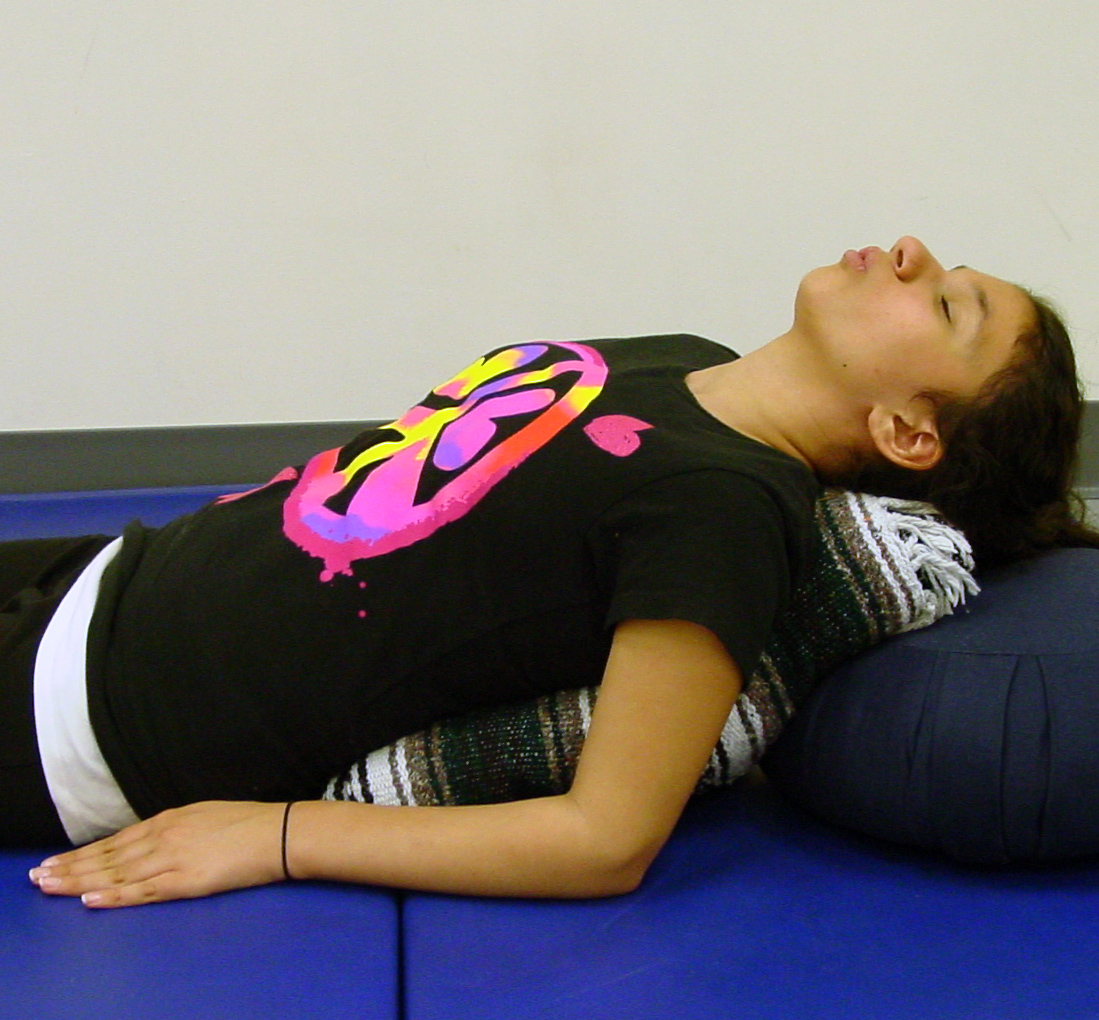
  • To modify, use bolsters and firm folded blankets to support chest and head as shown in photo at right.


More Valuable Booty ( Links) for ye...


Ye Pirate Phrases

Ye Pirates in the Clasroom ( Includes lesson plans & resources for teachers,
speech language therapists & adapted activities for non-verbal children)

Ye Pirate Festivals


See ye later Mateys!

Arr!
A Pirate-y Pool Noodle
Spy Glass


Contact ye captain:

barbara@bodylogique.com

Friday, September 7, 2012

In Case You Missed It: September 3-7 2012


Photo: ©2008-Barbara Gini
  "Play is the work of children. " ~Maria Montessori

As everyone settles into the new school year, I'd like to take this opportunity to remind everyone to make time to play.

Children are relaxed, receptive and learn best when playing, and believe it or not, so are adults. Play releases stress from the body, calms the mind, integrates the brain and body, builds social skills and stimulates the imagination. Play is a safe way for us to explore the world and to test (and expand) our boundaries.


Wishing you a play-full weekend!


~Barbara


The Absorbent Mind

The Theory of Play

Creating Inclusive Learning Environments

Soapy Slime Fun

Woman Creates "Sensory Sheild"

Sensory Games and Activities

Take it Outside

The Power of Water (and Wasted Opportunities)


Contact Barbara by E-mail

Visit our Website

Connect on Facebook

Follow on Twitter


.


Monday, August 27, 2012

Stretching the Limits

Photo: "Outer Space" Wallpaper
by CiCaTr1z on deviantART.com
This week, many are mourning the loss of a man who was an inspiration  in the realm of space exploration. Neil Armstrong helped stretch our imaginations and made an entire country believe that anything was possible.

I remember being four and a half years old, watching the broadcast with my mother, and seeing the dream-like images coming through our TV. My brother was only a month old, and I was barely old enough to understand the significance of the event, yet I knew by the look of intensity on my mother's face as she held my baby brother that something important was going on.

I'm not sure if those images or the feeling of awe had anything to do with it, but I have always been fascinated with science: the stars, the planets, the moon, and the question of, "What's out there?". My intrinsic motivation has always been driven by a desire to discover the answers to all of the questions I ask myself.

"While we mourn the loss of a very good man, we also celebrate his remarkable life and hope that it serves as an example to young people around the world to work hard to make their dreams come true, to be willing to explore and push the limits, and to selflessly serve a cause greater than themselves. " ~Statement from The Armstrong Family


 "...be willing to explore and push the limits.."

As an educator, I think that everyday we commit to that cause greater than ourselves by guiding children through their imaginations; by encouraging them to ask their questions (be it to themselves or out loud); and by nurturing a curiosity & willingness to explore and stretch their limits to find the answers. I believe that these are truly a few of the greatest gifts in life, and the most valuable skills that anyone - young or old-can have.

Thank you Neil.


  Star & Space Inspired Yoga Activities for Kids- by BodyLogique      

Coming Soon:

Star Quest S.M.Art Story™  Yoga-Based Curriculum


Contact: barbara@bodylogique.com


.


Friday, June 22, 2012

This Week: In Case You Missed it (June -18-22


Photo: thehotairballooning.com 
 Hello everyone and a very happy Friday! This week marked the official transition from the end of the school year to the beginning of summer. Congratulations to all of the graduates and families. We wish you a safe, happy and productive summer!

We are looking forward to selecting 6 winners of our S.M.Art Story™ giveaway on Monday, so be sure to enter !

(Use this link to get the information. )

I had some requests this week for specific topics relating to summer camps and activities, so this week I have posted the relevant articles from this blog that pertain to the most requested information from this week. Many of these posts have outside links as well. If you still can't find the information you need, please contact me by leaving a comment below or by e-mailing barbara@bodylogique.com

Have a great weekend!

~Barbara


Summer Sensory Scavenger Hunt

Preventing Summer Learning Loss

Play Encourages Spontaneous Engagement

Aromatherapy and Autism

The Importance of Hydration

Building Core Strength Through Movement Games

Beach Yoga

Sand Dollar Shakers


Friday, June 15, 2012

In Case you Missed It: Friday, June 15

Photo by Lisa DeLuca
spraygraphic.com
Well The end of the week is finally here. It was a productive one for me, and an enlightening one as well. It was the last week of school for many  and the start of some summer adventures for others!

This week marked a few milestones as well: my daughter successfully finished the 6th grade; my sons and my brother all turned a year older; I am on the verge of publishing my first two S.M.Art Story™ expanded curricula on Amazon; AND my blog has reached over 100,000 views!  I want to thank my readers and community partners for your inspiration, feedback and support of adaptive movement programming for kids. Without you, this program and these books would not exist.!

As a Thank You and to celebrate these exciting events, I will be giving away six copies (3 of each title) of my soon to be published S.M.Art Story™ books to six lucky winners! (Why six you ask? Well, June is the 6th month!)

Dragonfly's Adventure and Ocean Surf-ari:
2 of our S.M.Art Story™ Series books
What is a S.M.Art Story™?  Its a BodyLogique® Exclusive! Themed, yoga-based adaptive curriculum series for educators, therapists, yoga teachers & families to use as supplemental materials for children ages five to ten. They are fun, educational, therapeutic and completely user friendly. (You do not need to have yoga experience to use them.) They have been used (e-book version) in classrooms, camps, sensory rooms and home school programs all over the country.

Each curriculum aligns with core educational standards, national standards for PE, and supports health, well being, inclusion, sensory integration, social development & whole child learning. In addition, 10% of all sales help support our community yoga scholarship and helps to support our non-profit community partners.


Both of these expanded editions contain 3 complete lesson plans, photos, adaptive activities, games and dozens of classroom friendly yoga-based techniques for keeping kids of all abilities engaged, focused and calm. Both are in the final edit stages and will be available June 30 on Amazon, to educators, therapists and others who want to learn and use these effective practices. (The limited edition digital version is available here.)  We currently have plans for 12 - 15 books in the series and the next books in the series, "Sun Stretch" and "Star Quest" are due to be released over the summer.

If you would like to enter to win one of our S.M.Art Story™ books, you have two choices:

1)  leave a comment below (along with your current e-mail address so we can get in touch with you when you win!)
2) 'Like' us on Facebook or Twitter and leave a comment. (If you like us on both, your name will be entered 2 times!)

Winners will be selected by random drawing on Monday, June 25, 2012.

We invite you to   Subscribe to S.M.Art Kids / Healthy Kids by Email so you can receive up-to date release information, informative blog articles, workshop schedule and giveaway information right to your inbox, and we love connecting with other educators therapists and parents on Facebook and Twitter  if that is more your speed.

I also want to take a moment and wish my dad, and all of our dads a very restful & Happy Father's Day!

Here are this week's In Case You Missed It posts. Enjoy!


Please report broken links to:  barbara@bodylogique.com


A Bit of Fatherly Advice  (Stuart Duncan)

The ABC's of Assistive Technology (Valley Forge Educational Services)

Disability and Hate Crime (Autism Mumma Jeanette)

Playwork, Play Deprivation, and Play (The Journal of Play)

Constructive Fidgeting for Self Regulation (BodyLogique)

Opinion: Children Need Nature, not Facebook (Rich Louv via Children and Nature Network)


.

Monday, June 4, 2012

Sensory Scavenger Hunt: Nature Sounds

My daughter had  a friend stay over this weekend. Being 12 & 13 respectively, they spent most of their time sitting next to each other, TV on, texting friends. I kept kicking them out of the house as it was a nice outside, but it seemed like they kept going back to the electronics.

Usually, I just tell my daughter to give me her phone for a specified amount of time and do her homework, read or do some other activity, but I can't take away the phones of her friends.

So I enlisted their help with dinner and I gave them a challenge as we sat outside, husking corn on my patio.

I challenged them to a 'Sensory Scavenger Hunt' to see who could identify the most sounds.

They were not terribly enthusiastic as I had gotten them up off the couch and outside, away from cell phones & iPods and from watching "Soul Surfer" (an outstanding movie) for the 3rd time.

They blandly asked what the winner got. I told them that the winner got a 'free pass' for cleaning up the dinner dishes. They were slightly more enthusiastic at this point.

So I explained that all they had to do was sit (outside) and listen for 10 minutes and identify every natural sound they could hear. The phones were away at that point and phone sounds did not count. They agreed. They closed their eyes even though I didn't ask them to.

I began by identifying a woodpecker. My daughter said "Oh, is that what that is?"

My daughter's  friend identified a lawn mower in the distance. Even though it was not a 'nature' sound, I allowed it-the point of the activity was to get them to tune in with another sense other than their eyes.

The friend started naming sounds: a dog barking, a loud fan belt, someone emptying trash...my daughter noted that she would be able to play too & could hear better if her friend would stop 'blabbing' and just be quiet. The friend pointed out that my daughter has a 'bigger mouth' & louder voice then her, so she shouldn't be talking either....

So I suggested that they both just listen and they could write the sounds down later. They finally quieted and sat perfectly still. About 15 minutes later when I finished husking the corn, I told them they could open their eyes, and they asked if they could sit a few more minutes.

What?! Did they just ask to sit quietly a little longer?! Why of course they could! I actually did a little happy dance as I went inside to start dinner.

So 10 minutes later they came in the house and asked me for paper so they could write their lists.

Here is a partial list:

  • mom husking corn
  • the chair creaking
  • loud radio (from passing car)
  • birds (7 different calls that they imitated for me)
  • a dog whining (next door)
  • kids laughing
  • wind chimes
  • leaves blowing
  • water running ( neighbor watering garden)
  • roosters
  • more dogs (hounds barking down the street)
  • a church bell
  • my breath
  • my stomach growling
  • peace

I noticed that the list got more introspective as I hoped it would. The girls started out noticing generic external sounds and ended up where I wanted them: listening to their own internal sounds. This skill is not merely about listening. Its also about introspection & understanding ourselves: who we are & what makes us tick.

Although younger children are more enthusiastic to play this game, I know that teens need it more. They are growing and transitioning and need to learn how to get control of their emotions instead of the other way around. This exercise gives them permission to examine themselves, their dreams and desires and the choices that they are making for themselves.

Encourage your teens to do this exercise for 10 minutes a day. They will most likely resist at first, but then will ask for the 'down time' and finally, just take it for themselves.  You can adapt this activity to have them listen to a classical (or popular) instrumental music piece and identify all the instruments they hear. Have them write for 5 minutes a list or a brief description of what the music did & how it made them feel. Or let them listen to a 'nature sound' track and identify what they can hear from that.

In all of my teen yoga classes, this is the activity the girls ask for the most, followed by the "Massage Train" (which I will discuss in another post) If they are asking for it, then it must be something they need. If they are not asking for it, then introduce it to them and they will.

Some of us call this by different names: mindfulness - meditation - stress management. Whatever you call it, and however you teach it, it is an important skill that serves many purposes, personally, socially, academically, profesionally and in all other aspects of Life.

Contact: barbara@bodylogique.com


Subscribe to S.M.Art Kids / Healthy Kids by Email 


Friday, June 1, 2012

In Case You Missed it: May 28-June1

"Late for Work" Photo: Patrick Breen
I hope everyone had a fun and productive week! Before I get myself outside for the day, I want to bring to you this week's "In Case You Missed It" post.

For those of you new to my blog, each Friday, we feature the top articles (archived and new) that are relevant to those who work with children with social, sensory and learning challenges. The purpose of this weekly post is to expand and improve the scope of resources & information for families, educators & other professionals. We want to build connections with diverse resources to help each other stay informed in the most straightforward and entertaining way possible. I hope you will pass it on and share with those interested.

To read the original article, click on the title links below. Its as simple as that!  Please feel free to share, with the original links & authors referenced.

If you have an article link you would like to add, contact Barbara at the e-mail at the bottom of this post. Guest post submissions are always welcome. Please report any broken links to Barbara at the e-mail link below.

Have a Fantastic Weekend!

~Barbara
barbara@bodylogique.com


Advocates Say  Yoga is "Ideal" for People with Autism
(Daily Camera)

Why the Midline is Important
(Sensory Edge)

Improving Sensory Integration Through Sensory Games

(BodyLogique.com)

Moving Smart: Safety Safari
(Moving Smart Blog)


Horse Therapy Helps Autistic Boy
(autismawarenesspage.com)


Should You Draw for Your Child?
(Janet Lansbury)


*A 'MUST SEE' Video (13 minutes)

iPad Apps for Autism
(60 Minutes-Video)


.

Wednesday, May 30, 2012

Keep it Simple, Keep it Real

I'm asked often what the 'secret' is to getting and keeping children engaged in yoga-based activities, in this world of electronics and instant gratification.

My answer comes as a surprise: there is no deep mystery and no secret.

The truth (and non-secret) that we have to keep in the front of our minds, is that children, no matter how precocious they act or appear, are not little adults. They are still children. There are things in our adult world that will never appeal to them, so if you are to work with children, whether its holistically or traditionally, you must put your adult teacher/therapist ego-self aside, and think like a child.

There are unlimited number of ways to get a child's attention and keep it. Get on the floor with them and see the world from their eyes to find what appeals to them. If you can't find anything, then you are not observing them closely enough. Look again.

Children need structure, but they also need spontaneity. They don't respond to lecture, worksheets, drills, tests, confinement, boring rote tasks. They do respond to mess-making, challenges, things they're not supposed to do, exploration, imagination, and fun.  If your therapy, yoga, phys-ed, general or special education class does not contain at least one of these elements, then you will not engage them. If you are not engaging them they will not be motivated to learn. When motivation drops, this is where we see disruptive & other undesirable behaviors emerge. We can stop it before it becomes an issue by observing what motivates a child and using it to teach them. In any giving classroom that could be 16 different things. Yes, its a challenge, but its our job and exactly what we signed up for.

As educators, its our job to inspire & motivate kids to want to learn. Part of this process is making it fun. Some of us, in the process of growing up, working our way through college, finding jobs, paying a mortgage and raising a family have forgotten how to have fun. Educators are scrutinized and stressed and are expected to cram so much work into a relatively short period of time, that we forget that it should be fun, at least part of the time. We need to find our way back to that in order to do our jobs better and have fun doing them.

So I can't give you any actual secrets because there are none, but I will give you 3 pieces of advice:

Keep it Simple:
Regardless of the electronic toys and gadgets we have now, children will respond to simplicity, as long as its fun. If its messy AND fun, you've really got their attention. An empty box, a stick, a rock, a piece of clay...a simple walk in the woods, all have potential for natural, relaxed learning. Teach children how to be safe when they play, and how to keep their friends safe. Help them invent simple games that explore concepts & include everyone. All it takes is 5-10 minutes (or more if you have the time) of simple, imaginative play daily (even for teens and older kids)  and you will see how much it benefits their attitudes, cooperation & all the other work they do!

Keep it Real:
Be yourself. I cannot overstate this. Kids can spot phoniness a mile away and will call you on it. You are in a position to either build trust or teach them how to mistrust every single adult in their life. I knew a children's yoga teacher who used to change her voice when she was teaching a kids class. I don't mean that she changed her tone or vocabulary, I mean her voice changed-to an otherworldly "Glenda the Good Witch" voice that she didn't use anywhere other than in the yoga studio. She also used words that children don't normally use and they would never hear in a general education classroom-chakras &  mindfulness are 2 examples. Its okay for us to say "feelings" and "paying attention" instead of these other words. It doesn't change what we are teaching, it just makes the message more 'user friendly' & more easily understood.  So please use real language, your real voice and just be your real self.

Keep it Fun: 
Invent games, poems or songs with the students to teach your lesson or get your message across. Rhymes can be a great mnemonic for learning as well as a way to release tension and encourage cooperation. In one classroom I worked in, we always sang instructions to the kids:  (Think "Frere Jacques": ) "We are march-ing, we are march-ing, to our class; to our class...  is much more fun than, "Okay guys, line up..." A friend of mine who teaches older kids, uses songs like "Cotton eyed Joe" & "I like to Move It", playing  on a iPod to transition her students (dancing and laughing) to their next activity or class.

Fun comes naturally in the unexpected, so keep students motivated by doing at least one unexpected thing a week-better yet, one a day. You will find that it keeps you motivated too.


*What are some non-secrets you have that help you keep your students engaged? Please share them below in the comments!


Contact: barbara@bodylogique.com


Subscribe to S.M.Art Kids / Healthy Kids by Email